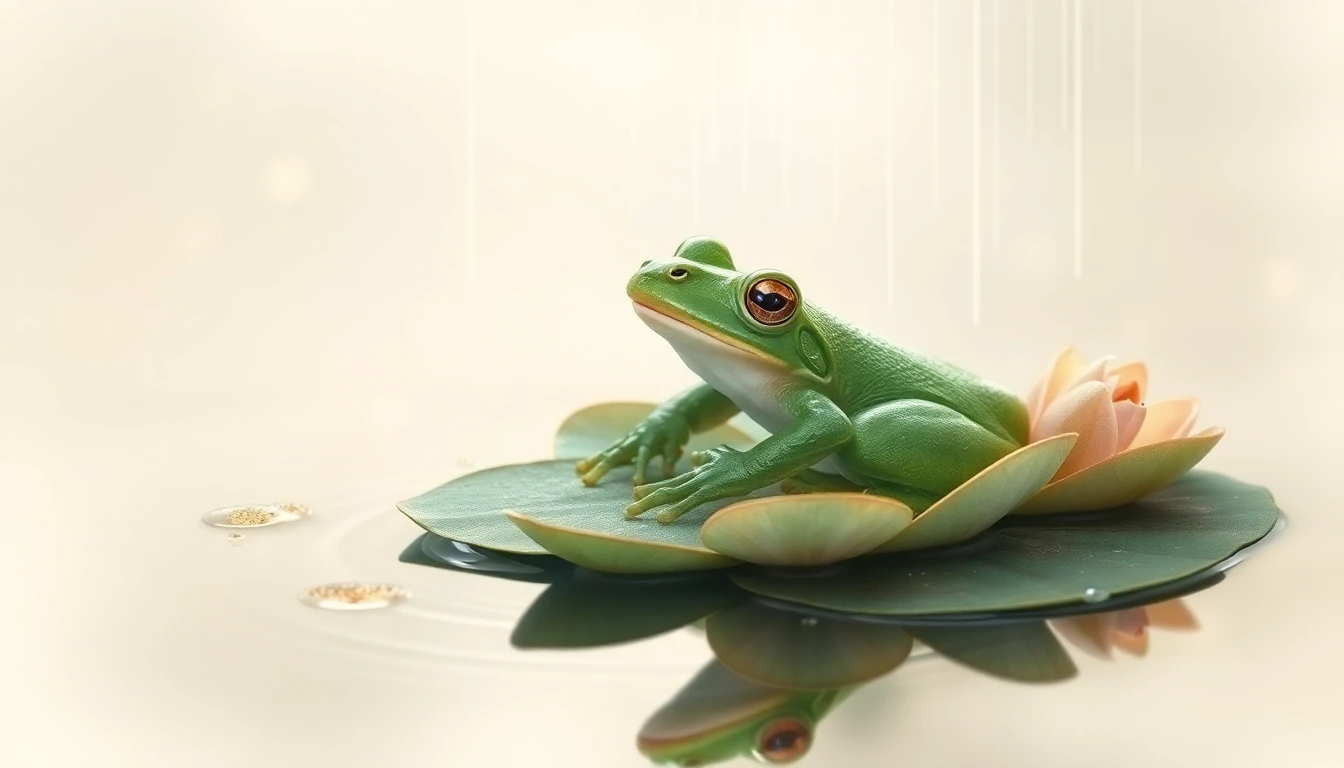
Spirit Animal
Frog — meaning, medicine, and teaching.
If you have been called "too sensitive" so often you have started to believe it, the frog is the animal who would quietly correct that — your skin is not failing, it is doing its job. In the Mesoamerican cultures the frog was a messenger of rain and cleansing; in Chinese cosmology he stands for the lunar principle. His medicine is water — in tears, in silence, in the calls that summon the rain.
The Medicine of the Frog
Frogs breathe partly through their skin. This permeability makes them extremely sensitive to their surroundings — it is why biologists use amphibians as an early-warning system for environmental pollution. A body of water where frogs disappear is sick long before other species show it. That sensitivity is the true medicine of the frog.
He brings the capacity to feel atmospheres others do not yet register: the heavy mood in a room, a worry no one is saying, a small change in the body. To carry the frog is to have a permeable skin — not a weakness, but a warning organ. The art is to wear the sensitivity not as a burden but as a gift.
In the Mesoamerican cosmos, especially among the Maya and Aztec, the frog was an animal of the Tlaloqueh — the rain gods — and his croaking was an invocation of weather. In Egypt the frog-headed goddess Heqet watched over birth; women often carried small frog amulets through labor. The link between frog, water, and birth is remarkably stable across cultures: the frog helps when something has to pass through wet, narrow passages to reach the light.
The Teaching
The first teaching of the frog is cleansing through weeping. In frog-lore, tears are not a sign of weakness but a natural cleansing process. To carry the frog is to be allowed to cry without apology — not performed, simply a bodily expression when it arrives. For women who learned not to "cry right away," this is a late, important permission. The biochemistry of emotional tears is measurably different from ordinary tears — they carry stress hormones the body is flushing out.
The second teaching is the voice that calls the rain. A frog chorus on a summer evening is loud, persistent, collective. Frogs call in layers — a choir you hear without seeing. To carry the frog is to raise your own voice when something around you has gone dry. Not pretty, not polite. Persistent, like a frog call. In the Soul Name guide the frog appears with women who have a long drought behind them and are ready to be moistened again.
The third teaching is metamorphosis from the tadpole. A frog begins as a kind of fish — with gills, with a tail — and step by step becomes a land creature, yet never loses its tie to water. Translated: even if you long ago "came ashore," you are not allowed to forget the water you came from. The child you were. The first home. The body, before it became a function. See more in the overview on power animals.
The Shadow
The frog shadow is complaint. Turning the call into a habit confuses cleansing with chronic protest. The second shadow is emotional permeability without filter — absorbing everything around you turns you into a channel for other people's moods. Frog-skin is porous, but it is still skin. It sets a border. The mature frog-bearer knows which wave to let pass through her, and does not stop every one.
If you would like to feel which of the five elemental archetypes you are carrying right now — and where your sensitivity is medicine versus where it is being borrowed by other people's weather — the free 60-second soul-type quiz is here. It gives you a first archetype hint without asking for an email — a small, dry place to stand for a moment.
When This Animal Appears
The frog arrives in phases when long-held feelings are ready to release. After a separation, after the death of a parent, after years of overload. He also comes when intuition is asked for again — when the intellect no longer knows what to do next. Sometimes he arrives after a return to a childhood pond, a place where you once caught tadpoles as a girl. Such returns are rarely coincidence.
Invocation
Frog, be my weather when I become too dry. Teach me to read my own skin as an instrument — and to weep when it is right to weep.