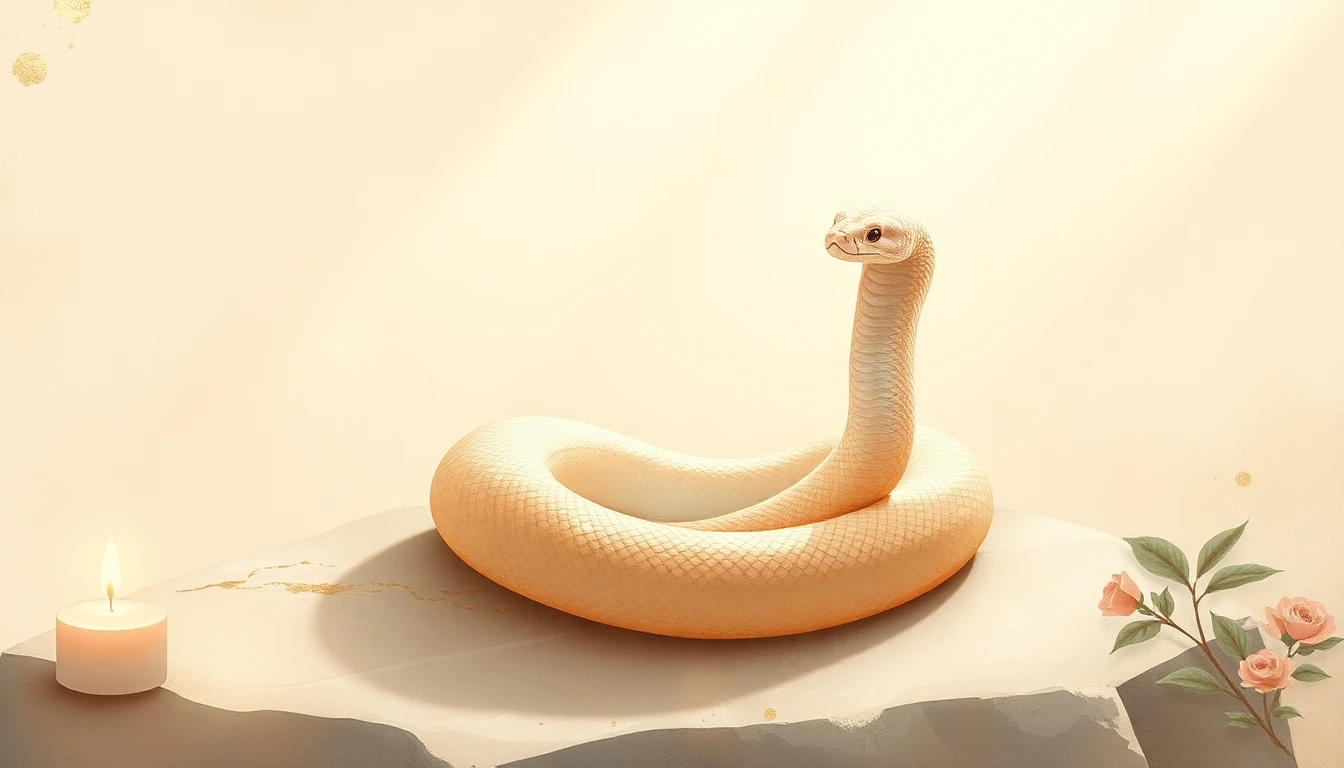
Spirit Animal
Snake — Meaning, Medicine, and Teaching.
If you have begun to feel that an old version of yourself no longer fits, but the new one has not quite stepped forward yet, snake is already at the threshold. She is the oldest symbol of healing and transformation we have. The Rod of Asclepius, the uraeus on the brow of the Egyptian queens, the kundalini of the Indian yoga traditions — everywhere she stands for the same thing: that which sheds, heals.
The Medicine of the Snake
A snake sheds her skin several times a year. Her old skin grows dull, dries from inside out, and she peels it off against rough stone or branch — backwards, in a single piece, the way you might pull off a glove. Without that shedding, the skin would not grow with her. Growth would mean suffocation. That is the biological ground of snake symbolism: the old must go so the new has room. Not as drama, but as hygiene.
The medicine of snake is therefore practical: she does not ask whether you want to let go, she asks where your skin has gone matte. Which conviction, which role, which habit has dried out? Whoever walks with snake learns that release is not a heroic act but a natural process you simply have to permit.
In the temples of Asclepius in ancient Greece, live, non-venomous snakes moved through the dormitories of the sick. Healing took place at night, often through dreams, under the protection of the Aesculapian snake. Almost three thousand years later, the snake remains the symbol of medicine — on the staff of Asclepius, in pharmacy crests, on the seal of the medical board. That is not accidental decoration but one of the most stable symbol-lines in European cultural history.
The Teaching
Snake's first teaching is ground. Snakes have no legs — they are body in constant contact with earth. They sense tremors before tremors become audible. Whoever walks with snake learns to take the belly itself as a sense organ. Many women have unlearned trust in their gut feeling because they were taught to be "reasonable." Snake makes the belly a witness again.
The second teaching is the art of waiting. A snake does not chase, she lies in ambush. She chooses her place so the prey comes to her, and then she waits, sometimes for days. That is hard wisdom in a world that rewards activity. Snake says: not every motion is progress. Sometimes stillness is the work. In the Soul Name guide snake appears for women stuck inside an old skin that has long grown too tight; you can read more in the overview of power animals.
The third teaching is venom as concentration. Not every snake is venomous, but those that are carry their venom in a small gland — concentrated, sparingly used. That is an image for words: truth that lands is not abundant — it is distilled. Whoever talks too much waters down the venom that should have done the work. Snake teaches economy of language.
The Shadow
Snake can become poison when she does not shed. Whoever refuses release and still tries to grow becomes toxic — to herself, to others. The second shadow is seduction: the snake of paradise as teacher of false promise. Whoever does not deal honestly with snake uses her to talk new skins onto people who do not need them. The biblical reframing of snake as evil is, by the way, relatively recent; in pre-Christian cultures she was almost universally honored as a feminine healing figure.
If you'd like to feel which of the five elemental archetypes is currently carrying you — and whether the old skin is ready to come off — the free 60-second soul-type quiz is here. No email needed for the first orientation.
When This Animal Appears
Snake appears at thresholds that are irreversible: after the last child has moved out. After the death of a parent. After a diagnosis that splits life into a before and an after. In such phases, going back is not an option, and snake comes to make that clear. Whoever wants to read more about the logic of such transitions can find the frame in the overview of power animals. She often announces herself in dreams — in many cultures, a snake in a dream is read not as threat but as the announcement of a transition that is about to become conscious.
Invocation
Snake, show me what has gone matte.
Be near me as I leave my old skin behind —
and let it lie where I found it.