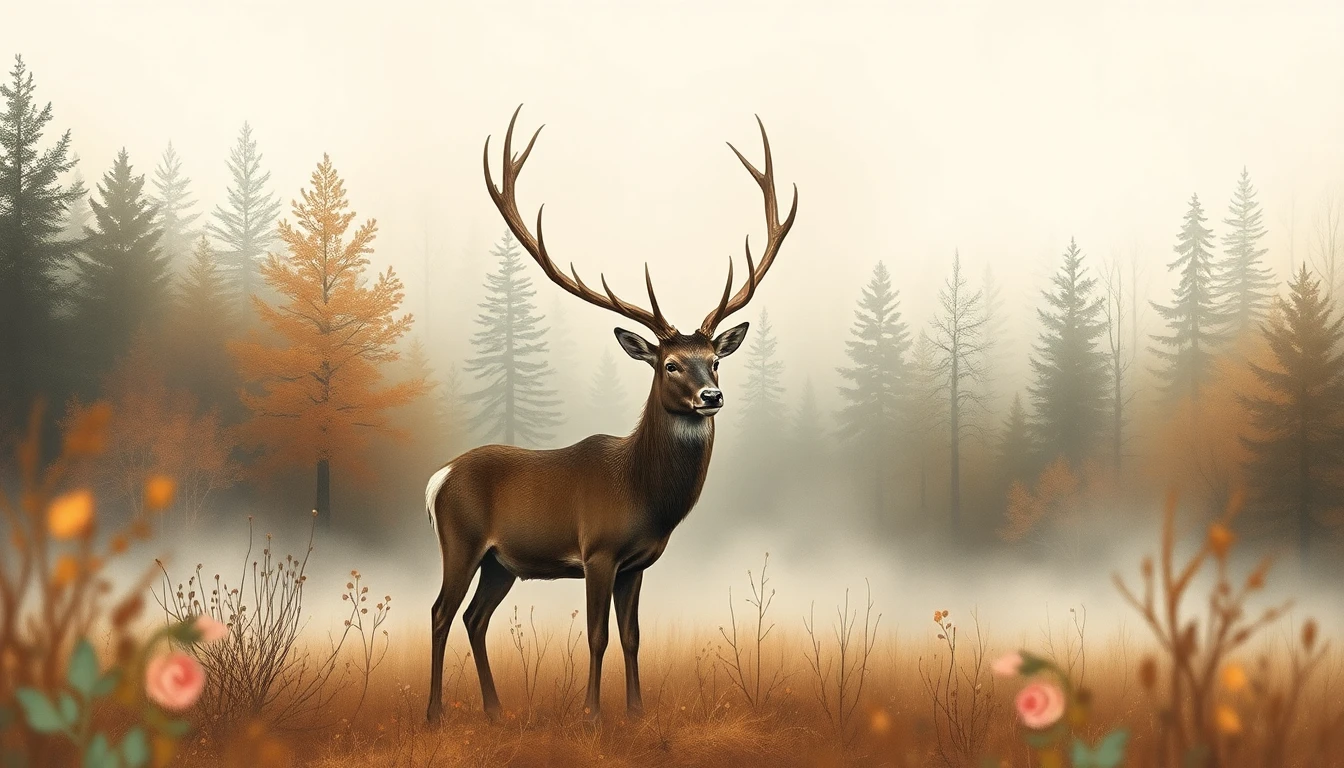
Spirit Animal
Deer — Meaning, Medicine, and Teaching.
If you have spent years quietly making yourself smaller — at work, at family tables, in your own body — and feel the tug back toward something tall in you, the deer has already noticed. In the Celtic and Norse traditions he wears the antlers as a self-renewing crown, most famously as Cernunnos. His medicine is carried dignity: upright without showing off, held by the forest rather than fought for.
The Medicine of the Deer
A red deer sheds his antlers every year. In the spring, the new beams grow at up to two and a half centimeters per day — the fastest bone growth among all mammals. During the growth phase the antlers are covered with a soft, blood-rich skin called velvet. Only when the bone formation is complete does the stag rub the velvet off against trees. That annual renewal is the biological ground of deer-symbolism: dignity is nothing fixed, but something that must grow new each year.
His medicine is therefore uprightness without strain. He carries the antlers not proudly but as a matter of course. To walk with the deer is to learn not to make oneself small — and to need no swagger to do it. A rare middle, particularly for women caught between "do not stand out" and "finally be seen."
In the Celtic cultural sphere, the horned god Cernunnos was honored in a rare double role: lord of animals, and at the same time mediator between worlds. He sits cross-legged on the famous Gundestrup cauldron, surrounded by animals, antlers on his head, a snake in his hand. That composition is no accident — it shows the deer as a figure who holds uprightness (the antlers) and connection to earth (sitting, animals) in the same shape. That is the image carried inside deer-medicine.
The Teaching
The deer's first teaching is gentleness that is not soft. Deer are not tame — anyone who meets one in the forest knows how distance-keeping they remain. But their watchfulness is not fearful, it is sovereign. They look first, then decide. That is the kind of gentleness many women over fifty are relearning, after decades of having to seem harder than they were. A deer turns his head when asked — he does not turn away, but he does not turn obediently toward you either. That self-motion is the actual lesson.
The second teaching is the rut. In late summer and autumn the stags call — a dark, long roar that carries through whole valleys. They fight, they show their size, they court. Then they withdraw. That is a bodily image for the right rhythm between visibility and retreat. Whoever walks with the deer learns that there are seasons in which one may show oneself — and seasons in which one disappears back into the forest. In the Soul Name guide the deer appears for profiles that have lowered their heads too long. The wider context lives in the overview of power animals.
The Shadow
The deer shadow is the display posture — the crown as show. Whoever wears the antlers only to impress has missed the medicine. The second shadow is the flight reflex: a deer who bolts at the smallest sound is an animal without inner ground. Translated, that means: whoever folds her dignity at the first criticism never really wore it; she only borrowed it. True deer-dignity survives an inconvenient remark without collapsing.
If you would like to feel which of the five elemental archetypes you are carrying right now — the inner ground beneath your bearing — the free 60-second soul-type quiz is here. It gives you a first archetype hint without asking for an email, and is a useful companion if you are in the season of straightening up.
When This Animal Appears
The deer arrives in life-phases when you must straighten up what has long been bent. After a long illness, after a humiliation at work, after a marriage that made you smaller than you were. He also comes in the transition from the serving woman to the self-defined one — when the children are gone and the question arises of who is being carried now. Typically he announces himself in spring, when the velvet grows, or in autumn at the rut — two bodily seasons that echo in the human body too.
Invocation
Deer, teach me to wear the antlers that have grown to me —
without decorating them
and without hiding them.