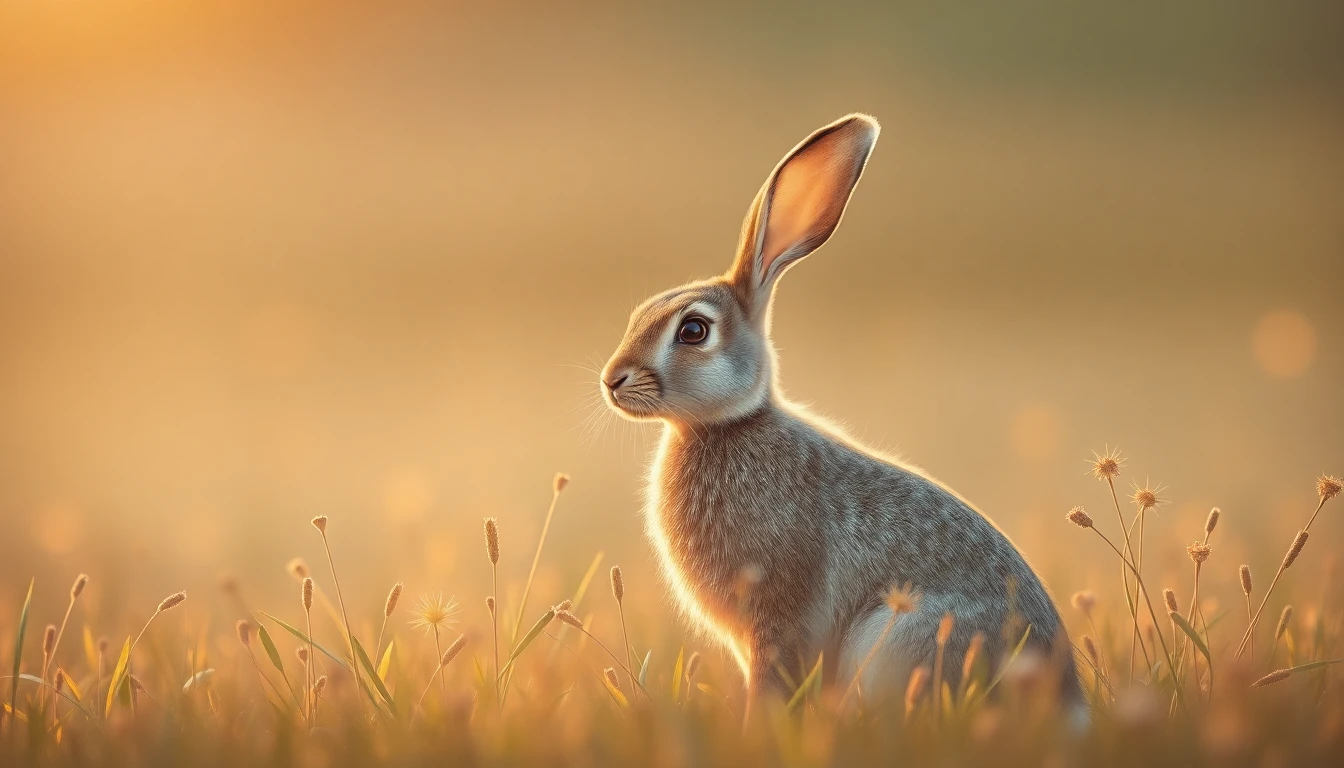
Spirit Animal
Hare — Meaning, Medicine, and Teaching.
If you have ever felt your body braced for flight long after the threat was gone — heart still quick, legs still tight — the hare may already be near you. He is the animal of the swift turn. In the old Celtic and Mesoamerican traditions he is regarded as a moon animal, as fertility messenger, and — among the Anishinaabe — as gift-bringer. His medicine is the intelligence of fear.
The Medicine of the Hare
A European hare can reach seventy kilometers per hour in flight and can pivot at ninety-degree angles without losing his balance. His spine is unusually flexible, his hindlegs asymmetrically muscled, so that he can change direction abruptly the moment he senses the pursuer's movement. The hare is not an animal that has fear and flees — he is an animal that turns fear into elegance.
His medicine teaches that fear is usable energy. Many spiritual systems want to dissolve fear. Hare says: do not dissolve, deploy. Whoever understands fear as alertness does not freeze but speeds up; not panicked, but precise. Especially for women who have been ashamed of their sensitivity, that is a late relief.
In the Anglo-Saxon and Central European spring traditions, the hare is the animal of the goddess Eostre — long before the Easter chocolate. His appearance in spring, together with eggs and lunar phases, marks the transition from winter into life. That the same figure shows up in several northern Eurasian cultures as moon animal and fertility messenger is no coincidence: the hare lives at the boundary between earth and sky, between what is visible and what will follow.
The Teaching
The hare's first teaching: sit until the moment comes. A hare stays in tall grass, motionless, often for many minutes before he runs. His strength is not flight but the timing of flight. Whoever walks with the hare learns to recognize the right instant — whether for leaving a marriage, quitting a job, or saying a long-withheld sentence. Premature movement betrays the position; getting up too late loses the chance. The art lies between.
The second teaching is the femininity of the moon. The hare is read as feminine in many cultures and connected with the moon — with cycles, with conception, with a fertility that is not only biological. In the wheel of the year everything has its time: sowing, waiting, harvesting, resting. The hare points back to the personal cycle, which for many women in menopause both ends and begins. The wider context lives in the overview of power animals.
The third teaching is groupless living. Hares are not herd animals; they live as solitaries or loosely together, and only in the spring "hare wedding" do they come together — the famous boxing of the females, who slap away unsuitable suitors. The hare is a chooser, not a worshipper. For women who live under the compulsion of constant connection, this is a quiet permission to choose for themselves with whom they are close, when, and how much.
The Shadow
The hare shadow is chronic flight. Whoever pivots at every sound arrives nowhere. Over-stretched alertness becomes a kind of panic structure in which the nervous system can no longer rest. The second shadow is shame at one's own softness: whoever is not allowed to use her fear because it is "unfitting" loses precisely the speed that could grow from it. The mature hare lives with his fear without obeying it.
If you'd like to feel which of the five elemental archetypes you carry right now — and whether your inner hare is being asked to sit, or to run — the free 60-second soul-type quiz is here. No email needed for the first orientation.
When This Animal Appears
The hare appears when you have endured too long in a situation that tightens you inwardly. He reminds you that movement is possible — but that the movement must not be hyperactivity, only precision. He also comes at the threshold of perimenopause, in mourning years, and after long relationships. A sign of his nearness is bodily: a quiet tingling in the legs, a need to simply run. That is not illness, that is hare-medicine speaking.
Invocation
Hare, teach me to sit still until the moment is ripe —
and then to pivot without guilt.
Make my fear into the alertness that shows me the way.