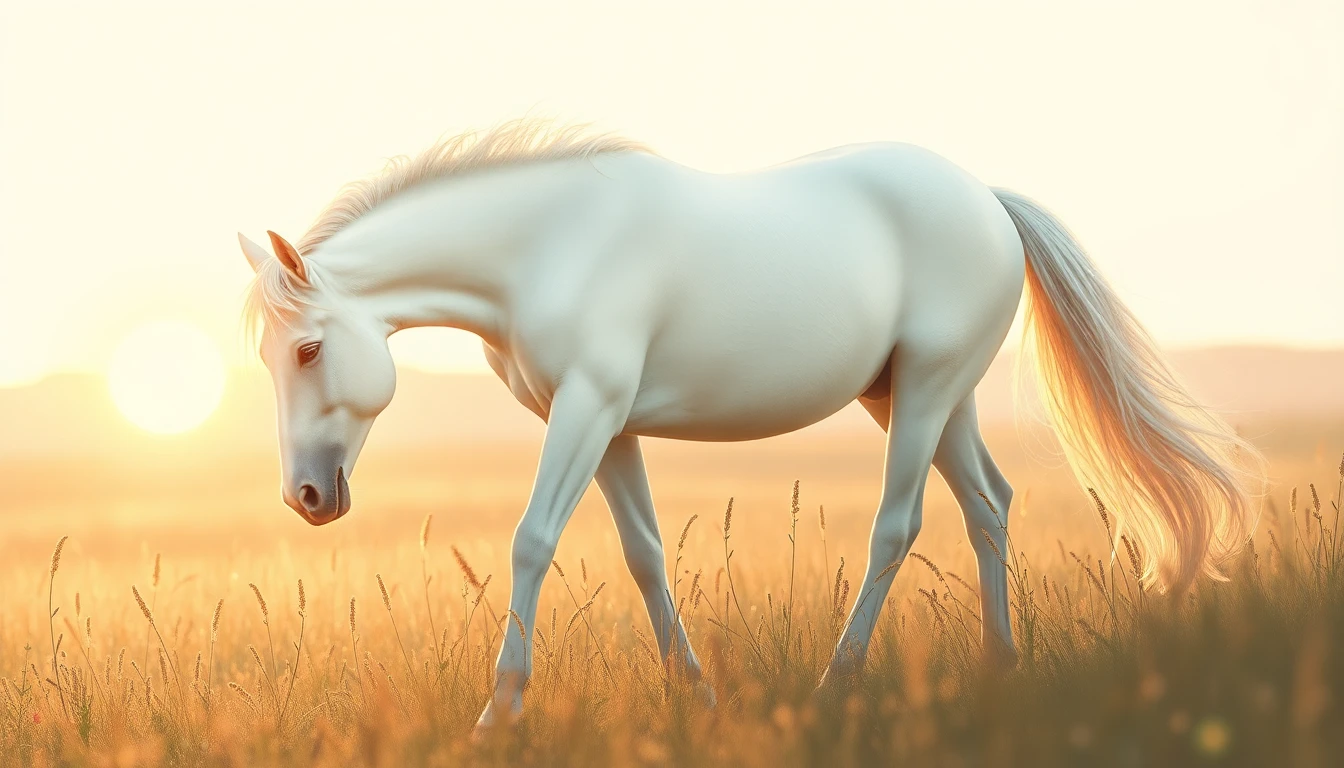
Spirit Animal
Horse — Meaning, Medicine, and Teaching.
If you have spent years carrying others without ever asking whether you are being carried in return, the horse may already be standing at the edge of your inner field. He is the animal of the bridge between strength and gentleness. Among the Mongols, the Lakota, the Celts — wherever people have lived with horses — he is regarded as companion, spirit being, and medicine animal. His gift is the conversion of energy into motion.
The Medicine of the Horse
A horse sleeps standing up. Its tendons and ligaments are built so that it can mechanically lock its joints and use almost no muscular energy doing so. Only in short REM phases does it lie down, often for only twenty minutes a day. That is not laziness but survival strategy: an animal that must be ready to flee can never fully switch off. This readiness is the ground of horse-symbolism — a wakefulness that is not tense but reliable. Only when other horses keep watch does it lie down for deep sleep. Trust as the precondition for letting go — that too is horse-medicine.
The medicine of horse is upright power held alongside tenderness. Horses can weigh half a ton and yet sense so precisely where the rider sits that they adjust their motion to the millimeter. That combination — being big and yet fine — is what horse brings as a power animal. Whoever carries it learns not to bridle her own size but to refine it.
Among the rider peoples of Eurasia — Scythians, Mongols, Huns — the horse was no tool but part of identity. Scythian graves often contained one or several horses meant to accompany the deceased. That bond is not romantic but existential: in the wide steppes, there was no survival without horse. Horse-medicine still carries that memory, even when we now drive cars.
The Teaching
The horse's first teaching is partnership rather than submission. A truly well-ridden horse does not obey — it attunes. Whoever walks with the horse translates that into her relationships: it is not about having or surrendering power, but about fine adjustment. What does the other feel? What do I feel? Where lies the shared rhythm? For women who have carried much in their marriages without being carried, this is a late, healing lesson. To ride is not to dominate the horse but to breathe with it.
The second teaching is freedom without flight. Wild horses range across wide landscapes, but in herds. For the horse, freedom does not mean aloneness, but going along at one's own tempo. Whoever carries the horse recognizes: independence and belonging are not opposites. Horse often turns up for women whose life-energy has long flowed for others and now finds its way back into its own gait. The wider context lives in the overview of power animals.
The third teaching is breath. Horses breathe in rhythm with their stride at the gallop — exhale on the front hoof strike, inhale on the rear. That coupling is bodily, not romantic. Whoever walks with the horse begins to bring her own movement and her own breath back into a natural relation — an antidote to years of shallow chest-breathing under stress.
The Shadow
The horse shadow is the constant run. Whoever only races eventually loses sight of who, or what, she is racing from. The second shadow face is the tamed horse who puts on her own bridle — the woman who can only spend her power in service, because she does not know how to use it for herself. Horse-medicine becomes effective only when the rider is also the one being ridden for. Until then, the most beautiful horse is only on loan.
If you'd like to feel which of the five elemental archetypes is currently carrying you — and whether your inner horse is being asked to slow down or to break into a gallop — the free 60-second soul-type quiz is here. No email needed for the first orientation.
When This Animal Appears
Horse comes when a new chapter of life demands movement — not hyperactivity, but real change of place. A move, a career shift, a journey that is not vacation but exploration. It also appears in seasons when you must learn again to feel your own body, after long years of functionality. Often it shows up for women who, after long years of caregiving, may finally feel their own joy of running again, without guilt.
Invocation
Horse, carry me when I want to be carried,
and run with me when I want to run.
Teach me that strength and fineness need each other, like hand and rein.