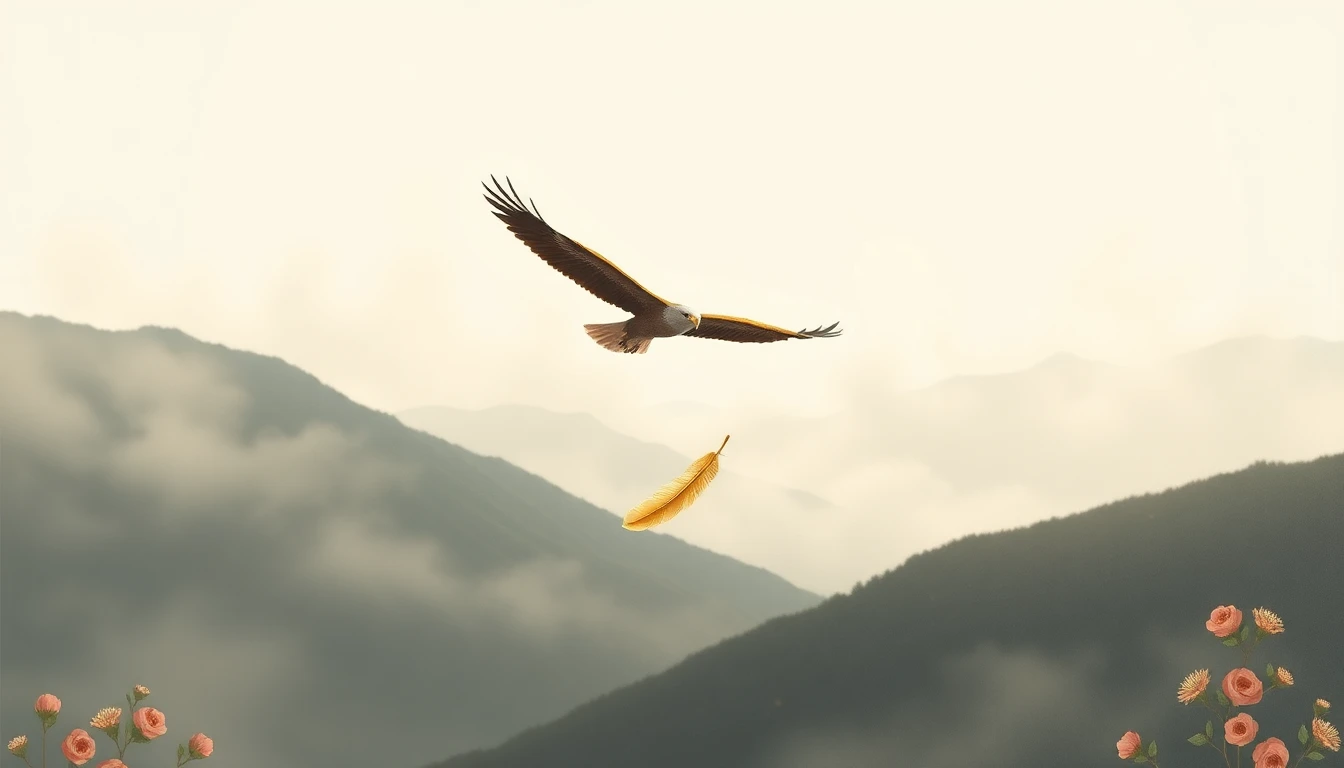
Spirit Animal
Eagle — Meaning, Medicine, and Teaching.
If you stand in front of a decision that you cannot see clearly from inside it — a move, a separation, a career leap, a conflict in which everyone seems to be right — the eagle is already circling overhead in the part of you that knows. In the traditions of the Plains nations of North America, and in the European symbolic canon as well, she is regarded as a messenger between sky and earth. Her medicine is the height that does not lose sight of the small.
The Medicine of the Eagle
A golden eagle can identify a hare from two kilometers up. Its retina holds nearly five times the density of receptor cells the human eye contains, and it sees with two foveae at once — one for the wide horizon, one for the close detail. That anatomical fact is the ground of its symbolism, not the other way around: the eagle does not stand for overview because it flies high, but because it can hold both gazes at the same time.
Its medicine follows from there: height without detachment. Perspective without losing the detail. To carry the eagle is to learn how to rise from the particular and return to it — without either place becoming more important than the other. A rare gift. Most lose closeness in the ascent, or stay below out of fear.
In the cultures of the Plains nations of North America the eagle feather is the most sacred of messenger gifts — and to this day is bestowed in ways tied to merit and service to the community, not to purchase. That reverence feels foreign in a culture that prints eagle symbols on coats of arms, cars, and beer labels. To meet the eagle as a power animal honestly is to know this double history: there is the actual eagle, and there is the European eagle-logo. They are not the same.
The Teaching
The eagle asks you to dare the height that belongs to you. Many women have spent decades shrinking themselves to avoid friction — in meetings, in families, in friendships. The eagle asks: what do you see that the others cannot, because they are too close? And it asks that you say it. Not loud, not polemic — but clear. Eagles do not call constantly. They call rarely, and when they do, the sound carries far.
The second teaching is patience with the thermals. Eagles do not flap, they sail — using rising columns of warm air to gain height with little effort. That is a practical image: there are moments in a life when the air carries you, and others when it is wiser to sit still. To walk with the eagle is to learn that distinction. To stop fighting the wind, and begin to read it. In the Soul Name guide the eagle appears for women whose path requires visibility, and the wider context lives in the overview of power animals.
The third, quieter teaching is monogamy across decades. Golden eagle pairs often stay together for life and return year after year to the same eyrie, expanding it until it weighs hundreds of pounds. That fidelity to one place, one mate, one task is another aspect of eagle wisdom: a wide view needs a fixed home. Whoever flies far without ever returning is not an eagle but a gull. The difference matters.
The Shadow
The eagle shadow is overflight. Whoever looks only from above loses compassion for those who work in the valley. Wide view becomes arrogance; clarity becomes hardness. The second shadow is the bird of prey who attacks because she can. Power without service is eagle-shadow. An eagle who strikes for the appetite of striking, not from hunger, is no longer a teacher but a tyrant. Mature eagle-medicine keeps the connection to the valley it rose from.
If you would like to feel which of the five elemental archetypes is rising in you right now — and from what height your decision wants to be made — the free 60-second soul-type quiz is here. It gives you a first archetype hint without asking for an email — a thermal under your wings before you commit to the wider view.
When This Animal Appears
The eagle comes in seasons when you must take a decision you cannot see from inside it. A move, a separation, a career leap, a conflict in which all parties seem to be right. The eagle appears when you need height to recognize the pattern. Eagle-time is rarely crisis-time — it is decision-time. As a sky-messenger, it naturally corresponds with the element of air, the breath that lets the wider view in.
Invocation
Eagle, lend me your wide gaze —
not to rule, but to recognize
where the next honest step lies.