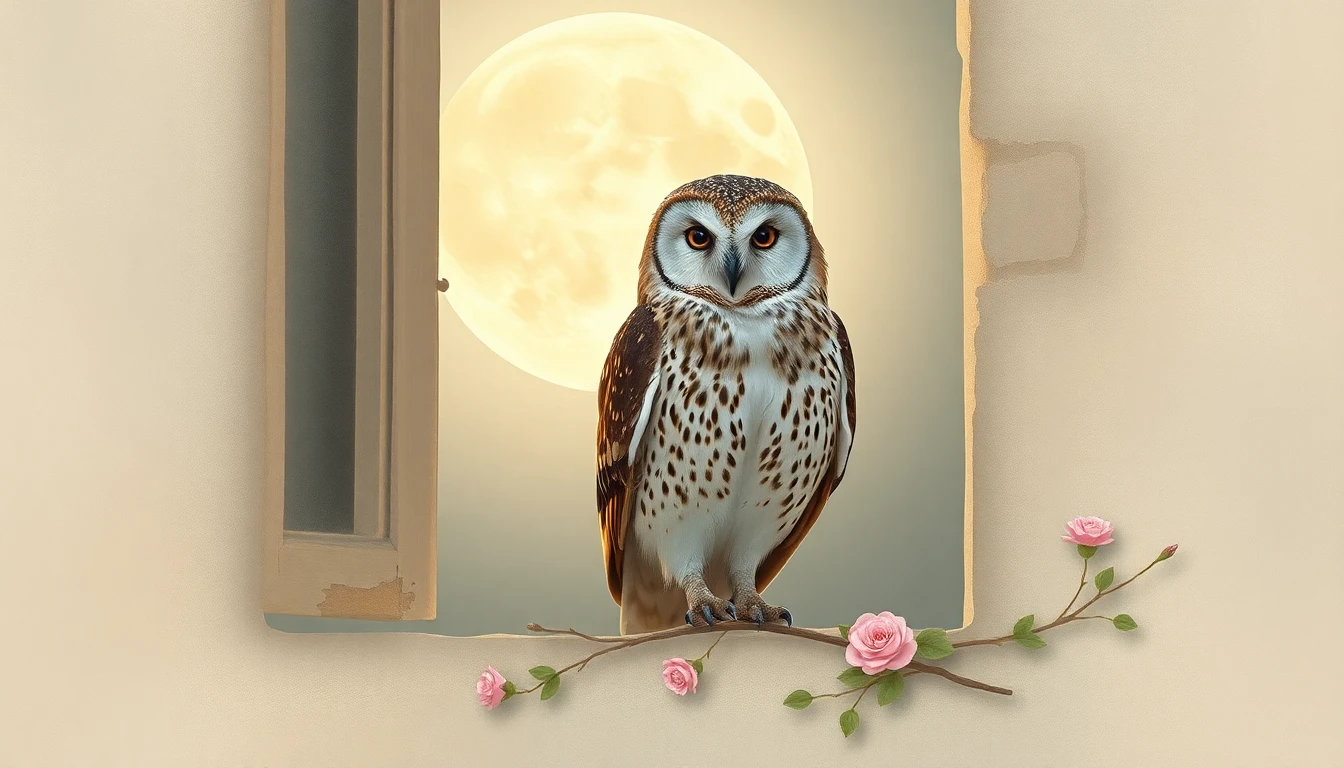
Spirit Animal
Owl — Meaning, Medicine, and Teaching.
If you have spent years sensing what no one else in the room is willing to name, the owl is not new to you — she has been near for some time. Since antiquity she has been the bird of wisdom — Athena's companion, the bird-form of the goddesses of the dusk. Her medicine is seeing when most are blind, and silence when most are speaking.
The Medicine of the Owl
Owls see at one one-hundredth of the light a human needs. Their feather structure includes a fine comb-like edge along the leading vane that breaks the airflow so completely that the wing-beat is nearly soundless. Engineers study this structure today to build quieter wind turbines. The owl moves silently not because she is mystical but because her wings are built that way. The mysticism is a by-product of the precision.
Her medicine is seeing in half-light. She brings the capacity to recognize things before they can be named: a mood, a coming problem, a lie that has not yet been spoken. Whoever walks with the owl has a fine sense for what runs beneath the official story. The gift makes no one popular. But it makes things clear.
Owls navigate almost as much by hearing as by sight. The asymmetric set of their ears lets them locate the movement of a mouse beneath snow with centimeter precision. They see and hear at once — a doubled wakefulness that European symbolism often overlooks. Athena, the Greek goddess of wisdom, did not keep the owl as her companion only for her great eyes, but because owl does both: she gazes and she listens.
The Teaching
The owl teaches the right timing of truth. She does not speak when everyone speaks. She waits for the moment when the other voices grow softer, and then she says one sentence that sits. That is an art many women over forty-five already know without naming it — and one they sometimes talk themselves out of, because they want to be polite. The owl says: do not be polite, be precise.
The second teaching is night as working time. Owls are nocturnal, and that is not a deviation but a role in the ecosystem. In a culture that worships light and demotes night to a rest break, the owl reminds us that much is born in the dark — dreams, intuitions, clarifications. To carry the owl is to keep nocturnal hours for yourself, without guilt. In the Soul Name guide she appears for women whose intuition has long been overheard, and the wider context lives in the overview of power animals.
The third teaching is solitude as a form of dignity. Most owl species are solitary or seasonally paired. They demand wide territories, much rest, little contact. To carry the owl is to refuse to pathologize aloneness. In this lineage it is a kind of presence, not a lack of presence. Women living alone after separations or in late life find an unspoken permission in the owl.
The Shadow
The owl shadow is surveillance. Whoever sees everything must also be able to look away — otherwise fine seeing becomes a burden, for herself and for others. The second shadow is flight from the world into the night: whoever lives only in half-light and avoids the day loses contact with ordinary life. The owl is meant to see through the night, not to drown in it. Mature owl-bearers balance these poles — they see deep, but they live in ordinary day.
If you'd like to feel which of the five elemental archetypes is currently carrying you — and whether your inner owl is being asked to speak, or to keep watching — the free 60-second soul-type quiz is here. No email needed for the first orientation.
When This Animal Appears
The owl comes in seasons when you sense something you cannot yet name. A sick atmosphere in the family, an infidelity that has not yet happened, an illness announcing itself, a workplace shift your colleagues do not yet see. In such times the owl appears — in dreams, in books, as a suddenly remembered childhood encounter. The classic moment is also late mid-life — a phase in which many women, for the first time, consciously become the owl they always already were.
Invocation
Owl, lend me your seeing in the half-light, and your silent flight.
Let me recognize without hunting —
and speak only when the sentence is ripe.