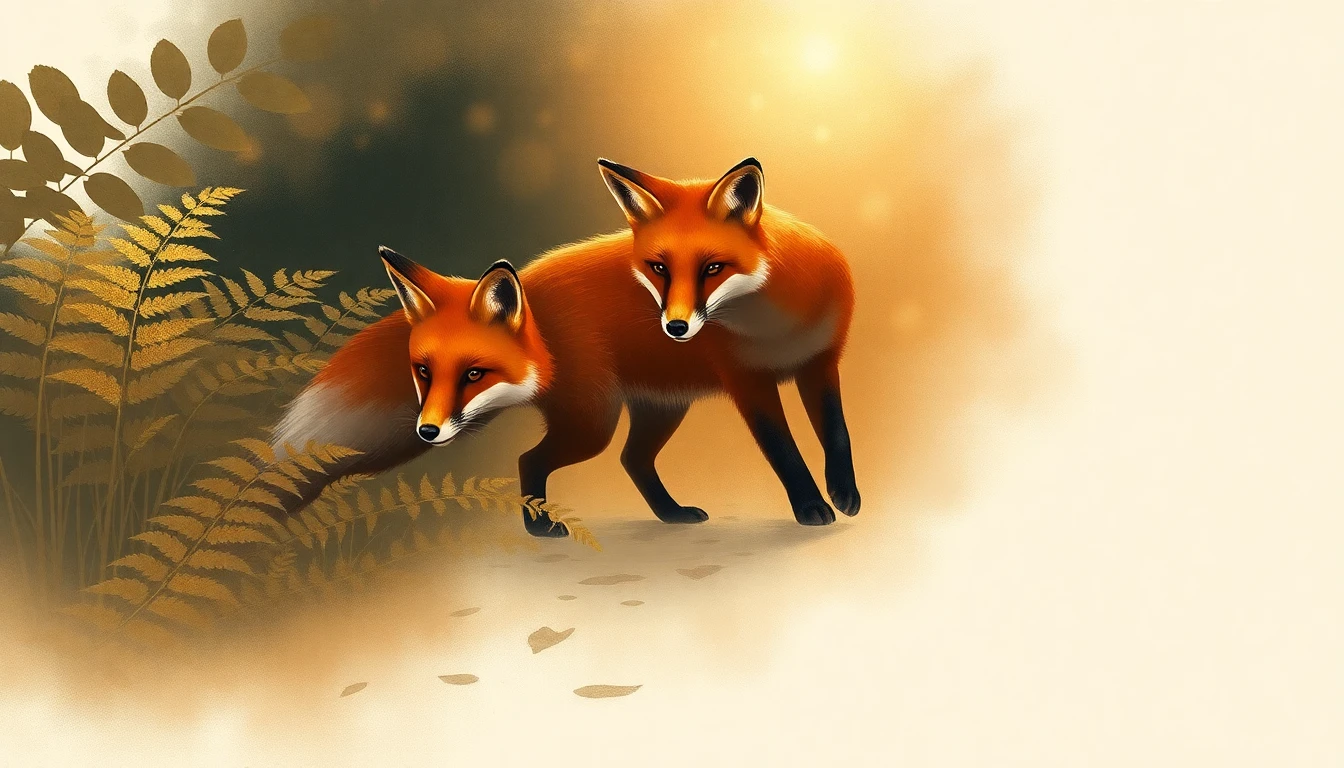
Spirit Animal
Fox — Meaning, Medicine, and Teaching.
If you have been told too often you are too much, too sensitive, too suspicious — and quietly suspect you have been seeing more than you have been allowed to say — the fox is the animal whose entire being is built around exactly that gift. In the Japanese Inari traditions, in the European Reynard tales, in the Coyote myths of North America, he is everywhere the clever one who does not walk through the middle but around the corner.
The Medicine of the Fox
The red fox demonstrably uses the Earth's magnetic field to hunt. When pouncing on a mouse he can hear but not see beneath snow or grass, he springs almost always in a north-easterly direction — and hits significantly more often that way. Researchers at the Czech University of Life Sciences confirmed this in a broadly designed study: the fox sees a field we cannot see. That, precisely, is his medicine.
He brings the capacity to recognize paths that are not signposted. In a culture that GPS-measures everything, that gift has grown rare. To walk with the fox is to know there is more than the main road. She takes shortcuts, she listens twice, she scents what lies behind the first explanation. That does not make her dishonest — it makes her awake.
In the Japanese Inari traditions the fox is regarded as the messenger of the rice goddess and is honored at hundreds of shrines as Kitsune — with an important distinction: the Nogitsune, the wild-forest fox, can be tricky or even malevolent, while the Zenko, the heavenly fox, protects people. That double nature is telling. The fox is no clean figure. He is gray zone — and that is his contribution to a world that otherwise divides too quickly into black and white.
The Teaching
The fox's first teaching: camouflage is protection, not lie. A fox who does not hide his red tip beneath the snow is dead. Translated: not every piece of information belongs in every room. There are spaces that demand clarity, and spaces in which silence is the only form of dignity. The fox releases you from the compulsion to be open always and everywhere.
The second teaching is mistrust of first impressions. Whoever walks with the fox does not believe the first smile, the first promise, the first diagnosis. She waits, she circles, she looks at the animal from behind. That is not paranoia — that is fox-cleverness. Women who were too trusting and have paid for it find in the fox a late, good companion. In the Soul Name guide he appears for women who are meant to take their gut seriously again. The wider context lives in the overview of power animals.
The third teaching is the interplay of closeness and distance. A fox pair tends the cubs together, and even after the young have moved on, a loose connection within the territory often remains. He is neither lone hunter nor pack animal — he lives in a third form: familiar yet independent. That is a form many mature women aim for in their friendships.
The Shadow
The fox shadow is calculation. Whoever always goes around the corner eventually stops going home. Cleverness that turns into manipulation is no longer fox but cold strategist. The second shadow is theft — the fox who breaks into the henhouse and kills more than he can eat. Translated: knowledge gathered but never used; secrets hoarded but never lifted. The mature fox-bearer knows when to leave the den and walk straight — without trick, without detour.
If you would like to feel which of the five elemental archetypes you are carrying right now — the inner field your fox is reading by — the free 60-second soul-type quiz is here. It gives you a first archetype hint without asking for an email — a quick sniff before the longer route.
When This Animal Appears
The fox arrives in seasons when a direct path will not work. A separation in which hard confrontation destroys more than it solves. A career situation in which you must enter through the back door because the front is locked. A family conflict in which silence creates more clarity than speaking. He often shows himself at dusk — at field edges, in cemeteries, in city parks. That is not a mystical sign but biology; and it is a sign nonetheless, if you allow it to be one.
Invocation
Fox, show me the path no one walks.
Let me be clever without growing cold —
and silent, where speaking would be war.