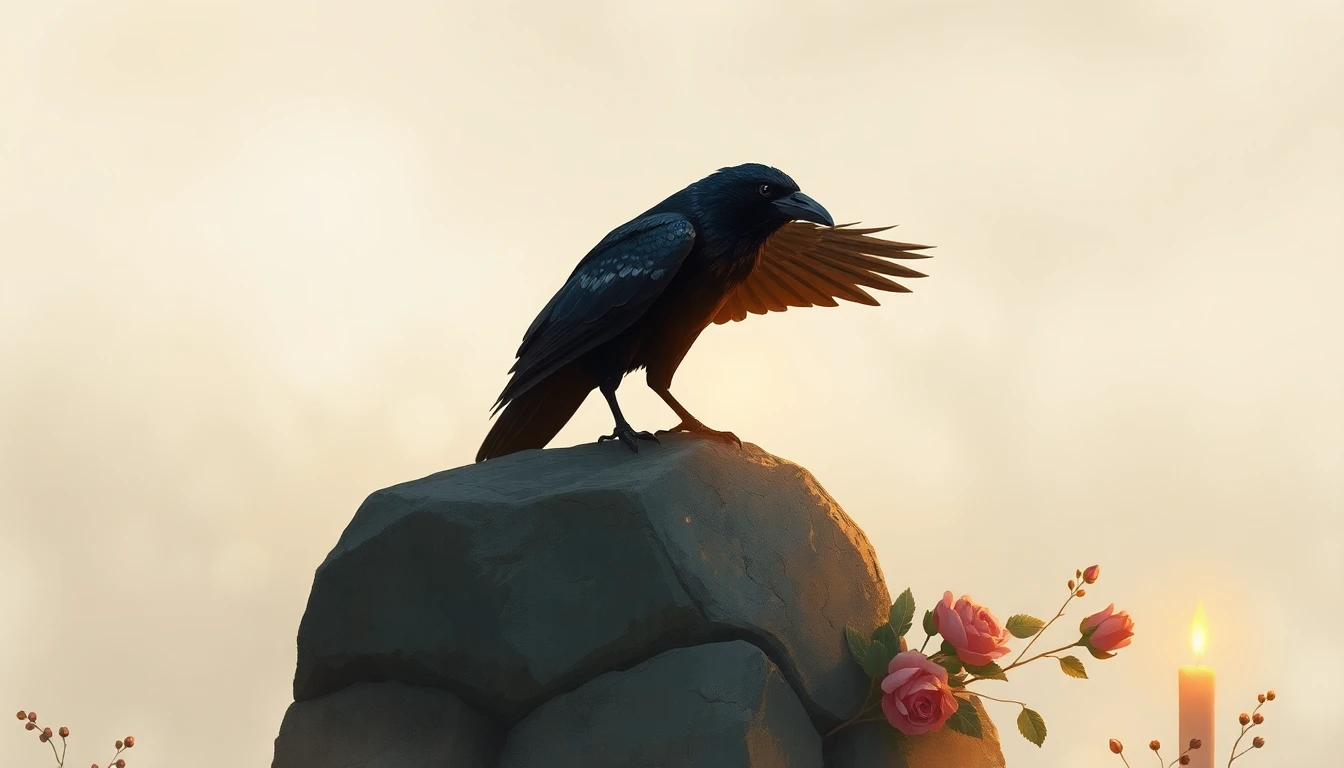
Spirit Animal
Raven — Meaning, Medicine, and Teaching.
If you have grown tired of being told to "stay positive" while life keeps showing you both ends of the spectrum, raven may be already perched at the edge of your awareness. He is the clever black animal between the worlds. Odin's Huginn and Muninn, the ravens of the Tower of London, the creator-raven of the Haida and Tlingit — wherever the raven appears, knowledge is at stake, and that knowledge crosses easily between dark and light.
The Medicine of the Raven
Ravens are among the few animals who demonstrably manufacture tools, solve problems by anticipation, and recognize individual humans across years. Cognitive researchers today rank them with great apes and dolphins. They leave gifts for people who have treated them well. They form pair-bonds that last twenty years and more. These behaviors are the biological foundation of their symbolism as bearers of knowledge — not the other way around.
The medicine of raven is therefore practical: it brings knowledge that does not lie in daylight. The side of a situation no one wants to name. The grief hidden inside a celebration, and the laugh hidden inside the grief. Raven is not a cheerful animal, but it is a buoyant one — and that distinction is its gift.
Among the Haida and Tlingit of the Pacific Northwest, raven is even a creator figure: a trickster who steals the light from a box and hands it to the world. That joining of cleverness, theft, and creation matters. Raven creates not from purity but from cunning. For women who have bound themselves too long to a notion of "respectable" spirituality, this is permission: insight is allowed to arrive sideways.
The Teaching
Raven teaches that intelligence without blackness stays hollow. Many spiritual paths try to live only the bright — positive affirmations, gratitude rituals, good vibrations. Raven does not contradict any of that, but adds: without the dark side, all of it goes thin. You are allowed to know that people die. You are allowed to know that relationships end, that bodies grow old, that not everything turns out well. That knowledge does not make raven cynical — it makes raven free.
The second teaching: humor as insight. Ravens play. They slide down snowy roofs, they steal prey from other birds in flight, they imitate voices. Whoever carries raven learns to take the heavy with lightness — not because it is not heavy, but because lightness is the only posture in which the heavy becomes bearable. In the Soul Name guide raven often appears for women who have learned to settle everything alone. The wider frame appears in the overview of power animals.
The third teaching, less often spoken, is pair-bonding. Ravens often stay together for life, tend their territory together, mourn at the death of a partner. So raven is not only a lone shadow-bird — it is also an animal of deep, decades-long connection. Whoever carries it may be both: black and faithful, clever and bound.
The Shadow
The raven shadow is knowing-better. Whoever walks too long with raven without keeping a heart beside it becomes the cynic — who sees through everything and loves nothing. The second face is carrion-eating in a figurative sense: collecting other people's stories, hoarding secrets, turning knowledge into power. Raven as confidante then turns into spy. The mature raven-bearer knows which knowledge she carries and which she must lay down, so as not to become a grave herself.
If you'd like to feel which of the five elemental archetypes is currently carrying you — and whether your inner raven is asking for laughter, or for silence — the free 60-second soul-type quiz is here. No email needed for the first orientation.
When This Animal Appears
Raven appears in seasons when you must speak an inconvenient truth — about yourself or about another — and must not lose your humor while doing it. It comes before funerals and after separations. It comes in the second half of life, once the bright promises of the first half have proven incomplete. Sometimes it arrives quietly: a single shadow on a country road, a sudden croak in a still moment. Raven does not impose itself. It waits until it is seen.
Invocation
Raven, witness me in the dark.
Teach me to see black without becoming bitter —
and to laugh, when the laugh is the last honest sound.