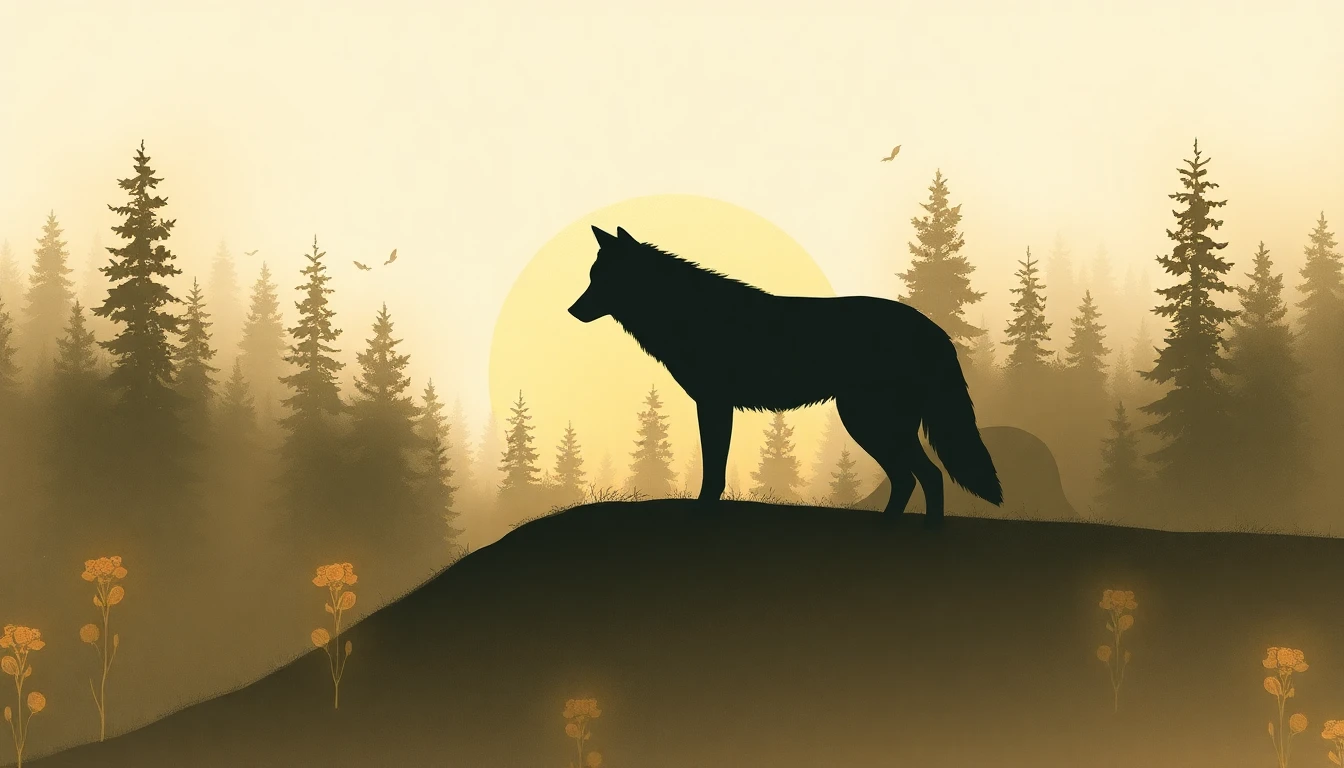
Spirit Animal
Wolf — Meaning, Medicine, and Teaching.
If you have spent years saying yes when the heart already meant no — and now feel a quiet animal at the edge of your forest waiting for an honest answer — the wolf has found you long before you searched. Across the northern Eurasian and Indigenous North American traditions, the wolf has been revered as a teacher of faithful boundary: serving the pack without betraying the self. In the language of modern Core Shamanism — the framework synthesized by anthropologist Michael Harner from cross-cultural fieldwork — the wolf is one of the classic power animals, distinct from the broader pop-culture term "spirit animal."
The Medicine of the Wolf
The wolf carries a paired gift that few other animals hold at once: deep pack-bond, and the capacity to walk alone through long, cold nights. A wolf pack is not a herd; it is a family — usually a breeding pair and offspring from several years. The hierarchy is not tyranny but responsibility. The leading animals eat last when the kill is small, and first when they need strength for a long hunt. This precision of role is the actual wolf-medicine.
Whoever walks with the wolf develops a fine sense for belonging: who am I truly here for, who is truly here for me, where does the pack end and the forest begin? This discrimination is not boundary in the hard sense. It is a quiet clarity — like the wolf who howls his territory's edge without needing to bite.
In the Norse myths, Odin's companions Geri and Freki are wolves of choice; among the Lakota, the wolf is regarded as a teacher of warriors and of mothers alike. Both traditions emphasize the same quality: to belong without dissolving. The she-wolf said to have nursed Romulus and Remus is no accidental image — she stands for that primal care which is clear before it grows soft.
The Teaching
The wolf's teaching often finds women who have spent a lifetime saying yes when the heart meant no. The wolf does not eat everything that crosses its path; it chooses, waits, refuses. An invitation it does not accept is not an offense — it is wisdom. Whoever carries the wolf as inner companion practices the no not as hardness but as precision. That difference is one many people only grasp after fifty.
The wolf also asks that you know your pack. By name. Not the colleagues, not the Instagram acquaintances, not the kind faces from yoga — but those three to seven people without whom you would not make it through a winter. The wolf forces you to write that list. And it asks whether you appear on the lists of others. To walk with the wolf is to stop managing relationships and begin living them. In the Soul Name guide the wolf shows up for profiles in which clarity and bonding need to be trained at once; the wider frame is described in the overview of power animals.
The Shadow
Overstretched, the wolf becomes the lone wolf — the figure who walks proudly out of every circle and sells her wounds as character. That is not wolf-medicine, it is wolf-shadow. To draw the boundary so hard that no one is allowed in is to forget that the wolf survives in the pack, not alone. The second shadow is fixation on hierarchy: when only the question of who is above and below remains, the responsibility of leading animals has been replaced by power-play.
The European fairy-tale tradition demoted the wolf to a symbol of evil — devourer of girls, beast, danger. That projection says more about our culture than about the animal. To meet the wolf as a power animal honestly is to acknowledge that layer without being ruled by it.
If you'd like to feel which of the five elemental archetypes is currently carrying you — and whether your inner wolf is being asked to howl, or to lie down — the free 60-second soul-type quiz is here. No email needed for the first orientation.
When This Animal Appears
The wolf usually arrives in seasons where social loyalty and loyalty to oneself collide: a marriage demanding a devotion that costs your I. A job where belonging is bought with quiet agreement. A family that expects you to hold everyone together until you fall apart yourself. In such times you begin to hear the wolf in dreams, see it at the forest edge, find it in old photographs and older fairy tales. It does not come to rescue. It comes to ask: whose pack is this, really? And it waits for an answer that is not polite.
Invocation
Wolf, teach me to walk without losing the trail of my pack —
and to stay without forgetting my own breath.
Show me which loyalty is mine to keep.