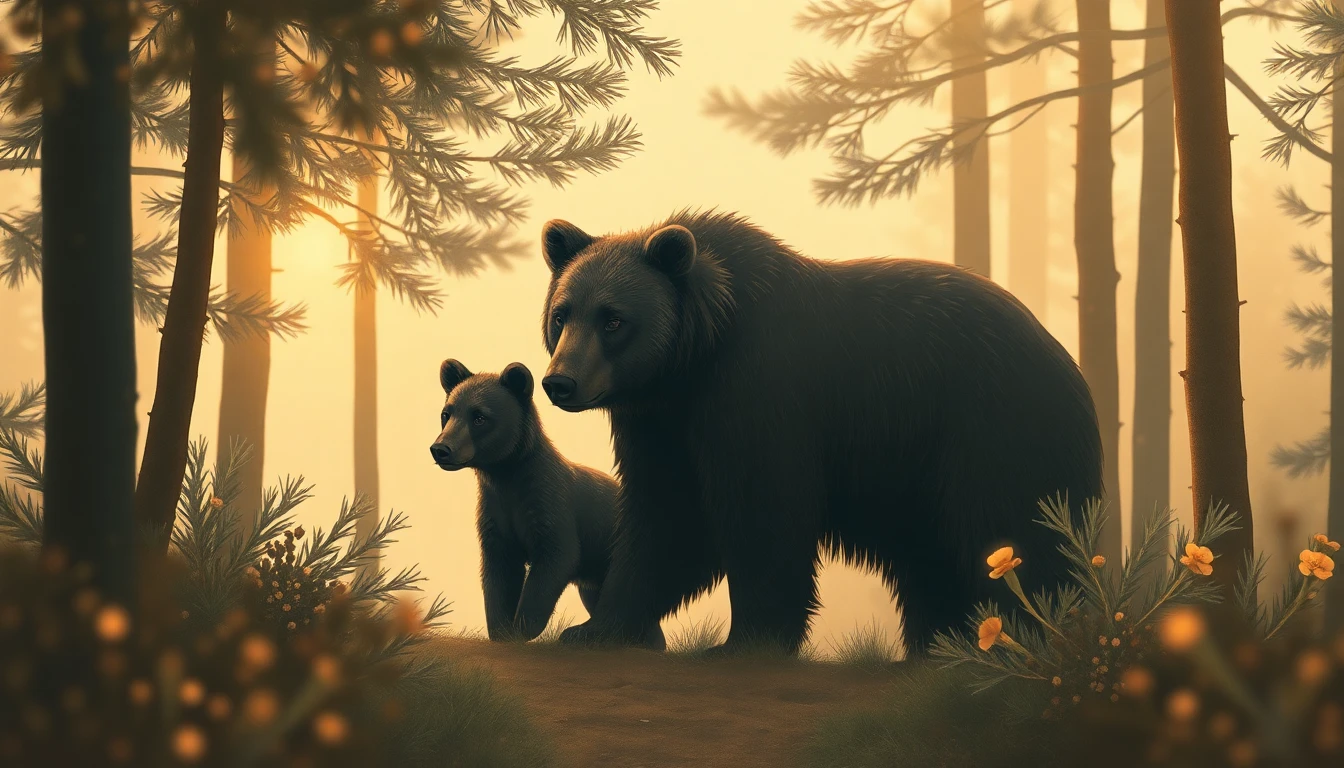
Spirit Animal
Bear — Meaning, Medicine, and Teaching.
If you find yourself running on empty and yet still apologizing for needing rest, the bear may already be standing at the edge of your field of vision. She is the great animal of winter — and her quiet, ancient permission is that you are allowed to stop without disappearing. Across nearly every northern culture, from the Ainu of Japan to the Sámi of Scandinavia, the bear has been honored as ancestor, teacher, and healer of women who were never allowed to stop.
The Medicine of the Bear
A brown bear sleeps up to seven months a year. Its heart slows to roughly eight beats per minute, its body temperature drops, and yet it loses neither muscle mass nor bone density. Researchers have studied this state for decades because it violates everything we think we know about effort and preservation. The bear rests and becomes, in the process, not less but more. That is its medicine, written in flesh.
It carries the right to winter. The right to produce nothing for months without disappearing. For women who learned that their worth is tied to their usefulness, that is a radical gift. The bear shows that the invisible counts too: digestion, processing, the patient waiting under snow. Whoever carries the bear stops apologizing for seasons of stillness.
In the shamanic traditions of the circumpolar north — the Sámi, the Evenki, the Nivkh — the bear is not just one animal among others. It is addressed as ancestor, often by indirect names because its true name would be too sacred to say aloud. People speak of "the grandfather" or "the one who lives in the forest." That reverence is essential. To carry the bear is to know it is an animal with history, not a decorative symbol.
The Teaching
The mother bear teaches two things that belong together: rest and boundary. A bear defending her cubs does not negotiate. She warns once, and then she strikes. That is not aggression — it is motherly clarity. Whoever walks with her learns that real care without a real boundary becomes exploitation. The mother bear does not say it twice. And she says it even when it looks impolite.
Second, she teaches the law of long digestion. Bears are omnivores who absorb everything before winter — berries, fish, roots — and then live for months from what they have stored. That is a bodily image for a psychic task: what you experience need not be processed at once. You may carry it with you into the winter. In a culture that demands instant clarity, that is heresy — and precisely for that reason, healing. Whoever uses the Soul Name guide will find the bear among profiles needing grounding and retreat. The wider context lives in the overview of power animals.
The third, often-overlooked teaching is omnivory. The bear is not picky. It eats roots and meat, honey and carrion. That universality is a quiet model: whoever carries the bear learns that nourishment is not ideological. What feeds the body, feeds it. Many women who have lived for years inside dietary rules find in the bear a permission to return to a broad, pragmatic way of feeding themselves — literally and otherwise.
The Shadow
Overstretched, the bear becomes inertia masquerading as depth. Winter rest is not depression, and retreat is not avoidance. Whoever never leaves the cave has confused medicine with symptom. The second shadow is the over-reach of the motherly boundary — the she-bear who attacks before being asked, who senses danger everywhere, whose territory is drawn so wide that no one is allowed close. Protection then becomes isolation. To carry the bear well is to distinguish between the sleep of rest and falling asleep in the face of the world.
If you would like to feel which of the five elemental archetypes you are carrying right now — earth, fire, water, air, or aether — the free 60-second soul-type quiz is here. It gives you a first archetype hint without asking for an email, and it pairs naturally with the kind of inner listening the bear teaches.
When This Animal Appears
The bear arrives in life-phases of exhaustion that no vacation can cure. After long years of caregiving, after professional burnout, after the loss of a role that held you for decades. It also arrives in perimenopause, when the body slows of its own accord and many women push back against their own nature. The link to the power-animal concept becomes, in such phases, not theoretical but bodily. You do not have to look long for the bear — it is often already there. You have simply been overlooking it.
Invocation
Bear, teach me the winter.
Teach me that my sleep is also work,
and that I am allowed what you are allowed: to rest until I am whole again.