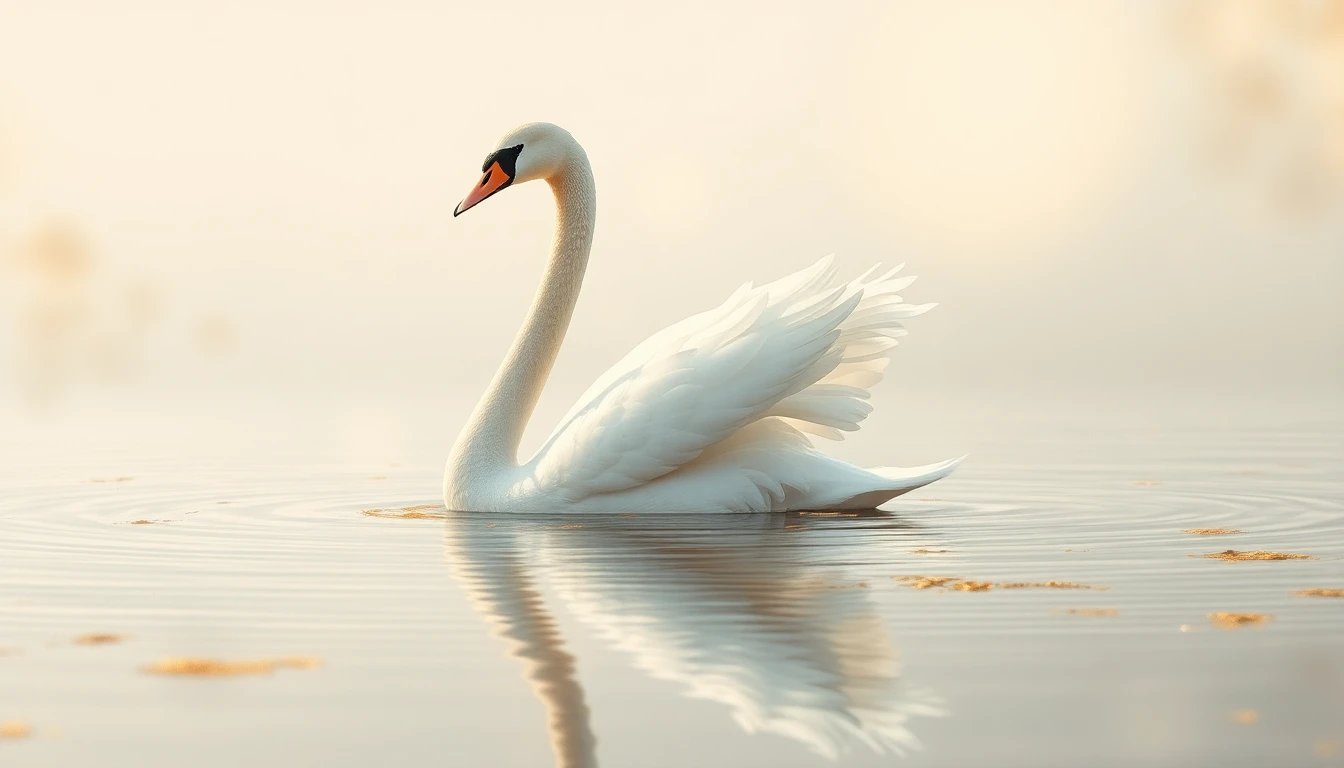
Spirit Animal
Swan — meaning, medicine, and teaching.
If you have spent a long time being called "graceful" while no one noticed the muscle behind the line of your neck, the swan has long known you. He is the bird of faithful dignity. In Irish legend, divine children are turned into swans; in Norse cosmology, swan-maidens carry fate. His medicine is the grace that does not collapse into fragility.
The Medicine of the Swan
Mute swans form lifelong pair bonds and defend their territory so decisively that a wing-strike can break a human forearm. A single wing can weigh five to six kilograms. The poetic figure of the "swan song" tends to obscure that physicality, but it is essential. The swan is beautiful because it is strong, not in spite of strength.
Its medicine joins two qualities that rarely sit together: grace and boundary. To carry the swan is to learn that gentle bearing and clear defense are not opposites. A woman who lifts her head quietly in a crowded room and draws a line without raising her voice has practiced swan medicine.
In the Irish tale of the Children of Lir, divine children are transformed into swans and must live nine hundred years in that form, until the ringing of a bell releases them. The story is not a fairy tale but a very old layer of Celtic cosmology: the swan is the animal of transformation between worlds, a bridge between human and spirit. To know that layer is to stop seeing the swan as a postcard.
The Teaching
The first teaching is the pair. Lifelong bonding, a myth in many species, is in swans often fact: when a partner dies, some birds refuse food, others find a new mate only after years. That is not romance, it is biology. To carry the swan is to take attachment seriously — without attachment hardening into stiffness. The teaching applies just as much to women who live alone: the bond is to any deep tie, not only marriage. An old sister, a friendship of decades, a place, can all be the swan's pair.
The second teaching is water as the element of transformation. Swans live on the threshold between water and air; they do not dive deep, but they always carry the upper body in light. It is an image of a way of living: do not deny the unconscious, but do not sink into it either. Swim. In the Soul Name guide the swan appears for profiles that are meant to live dignity through transition. See also the element of water.
The third teaching, often overlooked, is migration. Mute swans do not travel far, but whooper and trumpeter swans fly thousands of kilometers in V-formation, taking turns at the front — the lead bird carries the heaviest air resistance and is regularly relieved. To carry the swan is to understand that leadership rotates, that no one is always at the head. That is an important teaching for women who find themselves either chronically out front or chronically at the back. For wider context see the overview on power animals.
The Shadow
The swan shadow is the decorative. Wanting only to be beautiful — aesthetic, controlled, clean — loses the wing-strike. The second shadow is elite distance: lifting yourself too far above the duck-world brings loneliness. Swans are proud, not arrogant. The difference is fine but essential. A swan-bearer leaves the ducks in peace and lives her own form without holding it against them.
If you'd like to feel which of the five elemental archetypes is currently carrying you — and whether your inner swan is asking for stillness, or for a wing-strike — the free 60-second soul-type quiz is here. No email needed for the first orientation.
When This Animal Appears
The swan arrives in phases when dignity must be reclaimed — in relationships that have shrunk to logistics, in families that overlook the woman, in workplaces that demand form without substance. It also comes at the end of a grieving process, when grace returns without betraying the pain. Women who learn to walk again after widowhood often find in the swan the first form that fits who they have become.
Invocation
Swan, teach me the grace that has wings. Let me be beautiful without becoming soft, and stay faithful to me as you do to your pair. Show me the light on the water, even when it is dark underneath.