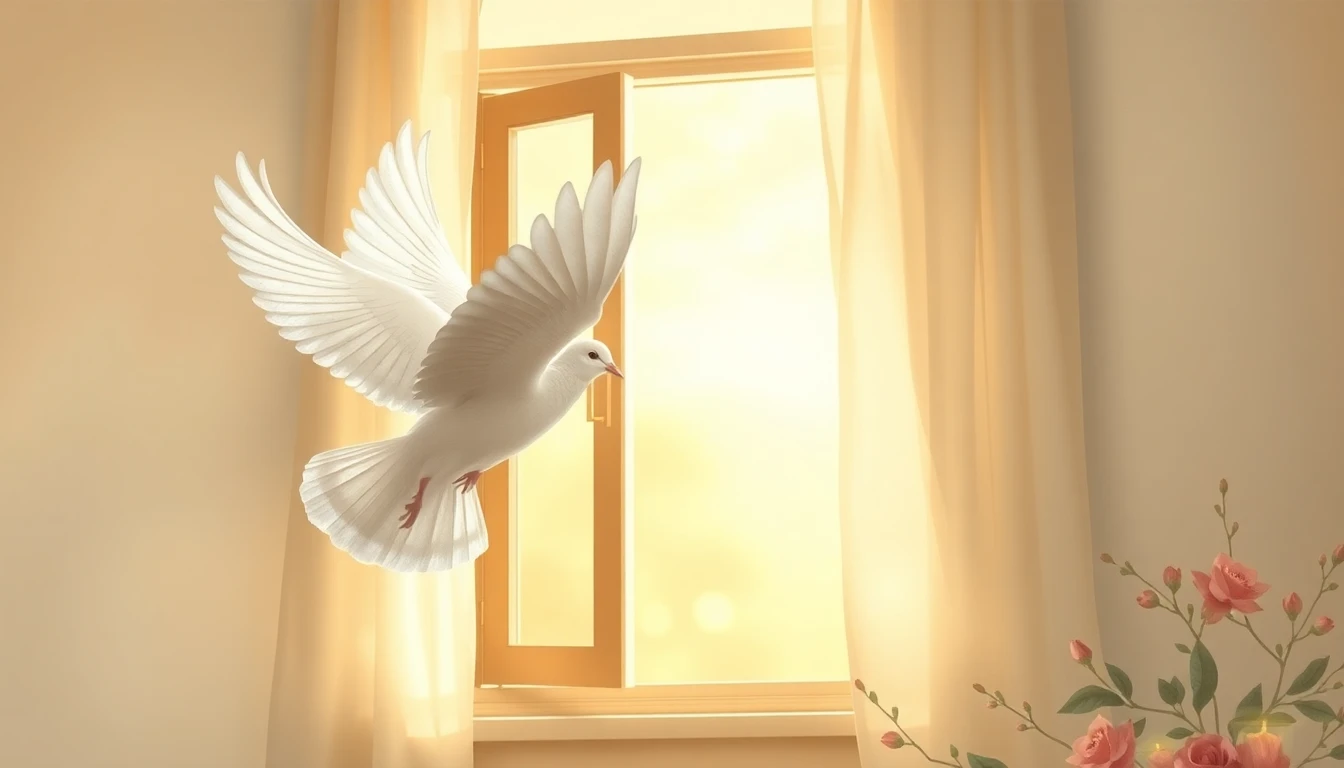
Spirit Animal
Dove — meaning, medicine, and teaching.
If you have been a stranger inside your own life for too long — geographically, emotionally, or just inside your own body — the dove has already begun to lead you home, even when nothing in your head yet knows it. For four thousand years across the Near East she has carried the form of the goddess: Inanna, Astarte, Aphrodite. Noah's ark returns to life through her. Her medicine is the capacity to find the way home, across any distance.
The Medicine of the Dove
Homing pigeons orient by the Earth's magnetic field, by the position of the sun, and — as more recent research suggests — by olfactory maps and very low-frequency sound waves they can hear across hundreds of kilometers. A pigeon released a thousand kilometers from its loft finds the way back, often the same day. That homing instinct is its medicine. In the Second World War carrier pigeons were sent with messages behind enemy lines, and several of them received service medals for saving entire units. Their reliability is historically documented.
The dove brings the gift of never being finally lost. Whatever foreign place you find yourself in — emotional, geographic, spiritual — something inside knows the way home. Anyone who has returned, after years abroad, into a familiar room and felt her breath go deeper despite all the changes, knows this medicine. For women who lost themselves inside roles that were not theirs, she is a quiet, dependable teacher.
In Genesis, it is the dove that returns to Noah with the olive branch in her beak, announcing the end of the flood — the waters recede, life returns. Across Mesopotamia and the Mediterranean, the dove was almost everywhere a feminine sign, often linked to love-goddesses like Inanna, Astarte, or Aphrodite. That the Christian tradition later turned her into a symbol of the Holy Spirit is a late layer on a very old trunk.
The Teaching
The first teaching of the dove is homecoming as an inner act. "Home" for her is not an address but a field. To carry the dove is to learn that home is located inside you — and that it cannot be lost, even when the outer home falls apart. That matters especially for women who have experienced migration, divorce, the loss of parental homes. The field is not gone, it has only shifted — and the dove knows where, before the mind grasps it.
The second teaching is peace as an active orientation. The dove as a peace symbol is not a passive bird — she is a messenger who returns through storms, who does not fight and still arrives. Peace, in her case, is not weakness; it is a heading that cannot be talked out of itself. In the Soul Name guide the dove appears with profiles who have spent a long time abroad and are allowed to arrive back. See also the element of air.
The third teaching is the cooing as inner tone. Doves coo softly, usually in the early morning before the city wakes. That cooing is a bodily sound the human can also find inside herself — a deep hum behind the breastbone, an inner murmur that calms without saying anything. To carry the dove is to find an anchor-tone in that hum that pulls you back in difficult hours. See more in the overview on power animals.
The Shadow
The dove shadow is the too-quick return. Whoever ducks every storm and flees home misses what the foreign place was trying to teach. The second shadow is the moralizing dove — the peace-loving one who holds peace up as a virtue while denying her own aggression. Authentic peace knows its own anger. The mature dove-bearer is not addicted to harmony, she is capable of peace — a difference that becomes visible in conflict.
If you would like to feel which of the five elemental archetypes carries you home — the field you orient by even when the address keeps changing — the free 60-second soul-type quiz is here. It gives you a first archetype hint without asking for an email — a small, gentle coordinate when nothing outside has yet settled.
When This Animal Appears
The dove arrives in phases of return — after years of absence, after grief, after upheavals when you no longer knew where to go. She also comes after inner exile: when you have been a stranger to yourself for a long time and are now arriving back at yourself. She is often seen in the first weeks of a new home — as if she were quietly co-signaling the arrival, without insisting on attention.
Invocation
Dove, lead me home when I no longer know where I am. Teach me that the field is inside me, and that any storm is allowed to carry me only for a while. Coo to me when it grows quiet.