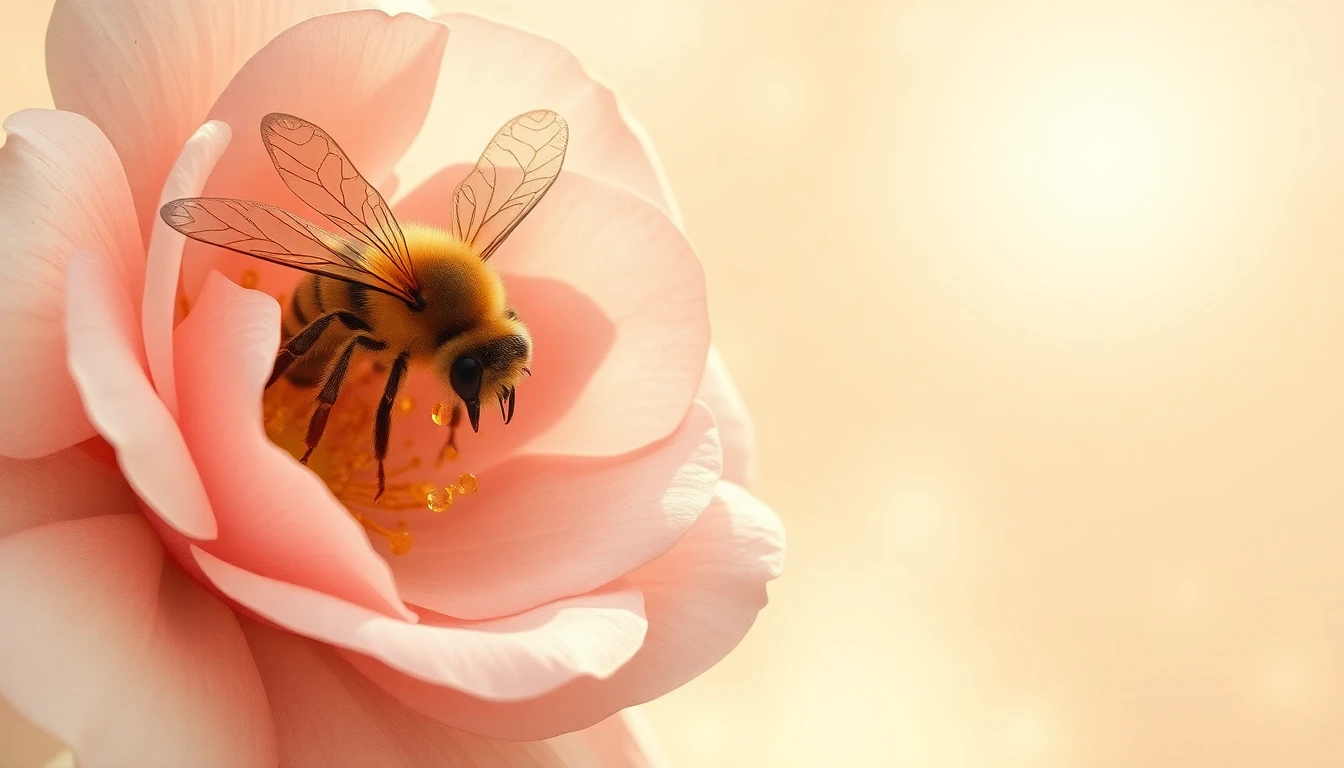
Spirit Animal
Bee — meaning, medicine, and teaching.
If you have spent years on small, repetitive work that no one counted — one conversation a day, one meal cooked, one letter written — and quietly wondered whether any of it added up to anything, the bee is already on your side. The Minoan priestesses who carried her name knew what most of us forget: a honey jar is never one bee's work. Sweetness is made of generations.
The Medicine of the Bee
A single bee produces about a twelfth of a teaspoon of honey in her whole lifetime. To gather one gram, the bees of a colony together visit up to eight thousand blossoms. No single life is enough to fill a jar. The honey is always collective work — and passed across generations as well. That fact is the foundation of bee symbolism: sweetness arises from many small, precise actions that no one can take credit for alone. It is exactly why honey was, in nearly every culture, a sacred offering and a gift of the gods.
Her medicine teaches that meaningful work need not look big. A woman who spends years having one small conversation a day, cooking one meal, writing one letter, has filled a honey jar without anyone counting the hours. The bee dignifies that without sentimentality.
In Greek and Roman poetry the bee was often called "daughter of the Muses"; Virgil wrote about bee colonies as if they were models of the human polis. Among the Celts, honey was liquid gold, an offering for the ancestors, and the druids were said to read part of their wisdom from the humming of hives. The connection between bee, knowledge, and transformation is remarkably stable across European traditions.
The Teaching
The first teaching of the bee is the dance. Bees show their sisters the direction and distance of a nectar source through the so-called waggle dance — a symbolic communication form decoded by the ethologist Karl von Frisch in 1944. To carry the bee is to learn how to point others to where they will find what they need, without making your own work depend on whether they thank you. Sharing knowledge without owning it is one of the hardest and most necessary acts of maturity.
The second teaching is devotion to something larger without self-erasure. The bee serves the colony, but she is not its slave — she dies when she stings, and that boundary is absolute. Translated: serve, yes. But not beyond your own existence. In the Soul Name guide the bee appears with profiles who have worked for a long time and now ask, freshly, what the work was for.
The third teaching is the rotation of roles — gatherer, nurse, guard. A bee passes through several occupations in her life: young bees are nurses inside the hive, older ones become builders, guards, and only at the end foragers. The job changes with age. Translated: a woman does not have to play the same role for fifty years. It is biologically appropriate to change tasks, and the change is not a resignation but a ripening. See also the overview on power animals.
The Shadow
The bee shadow is overwork. Turning diligence into an idol confuses medicine with symptom. The second shadow is swarming without your own dance — flying with the mass, joining without direction. To be a bee means to work, but also to know which blossom. The mature bee does not die of exhaustion but at the natural end of her life.
If you would like to feel which of the five elemental archetypes you are carrying right now — earth, fire, water, air, or aether — the free 60-second soul-type quiz is here. It gives you a first archetype hint without asking for an email, and many bee-bearers recognize themselves in it before they have finished the last question.
When This Animal Appears
The bee comes when the question of meaningful work wakes up again — after a change of job, in retirement, in a parental role that is shifting. She also arrives when the collective dimension of your work becomes audible again, after years of thinking individually. Often she shows up in a perfectly ordinary moment: a summer evening in the garden, a lavender bush, a single buzzing — and the sense that something larger than you is at work.
Invocation
Bee, teach me the small, exact flight. Make my work a drop of honey the colony never counts and never forgets — and show me where the next nectar I need is standing.