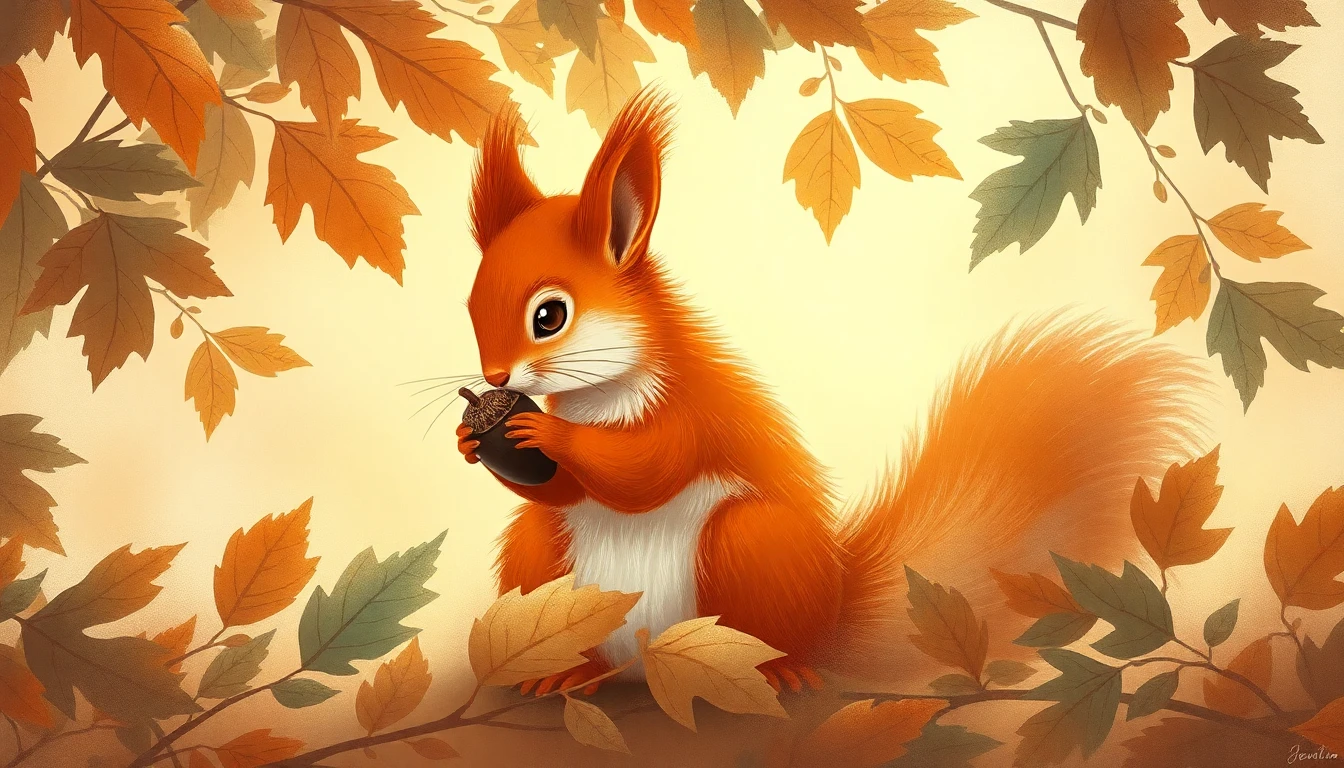
Spirit Animal
Squirrel — meaning, medicine, and teaching.
If you have spent decades managing every detail and have only recently begun to suspect that some of the nuts you bury are meant to become forest, the squirrel is already on a branch above you. He is the animal of provision. In Norse myth, Ratatöskr races up and down the world-tree Yggdrasil, carrying messages between the worlds. His medicine is the art of saving for later without losing the joy of today.
The Medicine of the Squirrel
A squirrel hides several thousand nuts each autumn, in hundreds of separate spots — sometimes up to ten thousand individual caches per animal. Its spatial memory is impressive but not complete: it forgets a portion of the hideouts. Those forgotten nuts sprout later, and the squirrel becomes the unintentional reforester of the woods. It is not perfection that makes him effective, it is the forgetting. Large parts of Europe's oak forests are biologically squirrel-work, without the animal ever having that intention.
That is his medicine. Gather, provide — but do not try to keep everything in hand. The gap in memory belongs to the gift; it is not a flaw. To carry the squirrel is to recognize that abundance does not arise from airtight control but from generous activity, part of which has to be released. Many women over forty-five have administered every detail for decades; the squirrel relieves them of that.
In Norse mythology Ratatöskr carries insults between the eagle in Yggdrasil's crown and the dragon Nidhogg at its roots — a sharp-tongued messenger who keeps the worlds in conversation. In that reading the squirrel is not the cute woodland creature but an agent of communication between levels. Whoever carries him tends to translate between worlds: between generations, between social milieus, between the sober and the spiritual.
The Teaching
The first teaching of the squirrel is provision without scarcity-thinking. He gathers, but not out of fear. His hoarding is natural, light, almost playful. He leaps from branch to branch, pauses, eats in between. The work is not separated from the life. To carry the squirrel is to treat retirement savings, reserves, and rainy-day funds as part of the everyday — not as objects of dread. A reserve gathered in joy tastes different in winter than one made in panic.
The second teaching is the lightness of movement. Squirrels are acrobatic; they use the tail as a balance pole. To walk with the squirrel is to learn to leap between projects without losing the trail — multi-talent without scattering. In the Soul Name guide the squirrel appears for women who are allowed to gather for their own old age without sacrificing the present.
The third teaching is the dray — the spherical nest squirrels build from twigs, moss, and grass high in the branches. Several drays per animal, used in different seasons, often with multiple exits for emergencies. That is a remarkable real-estate concept: not one house, but several small refuges. For women who know the feeling of "not really being at home anywhere," the squirrel is an invitation to plurality — many places, each one a home. A friend's flat, a holiday apartment, a familiar corner in a café can together be what a single house cannot provide. See also the overview on power animals.
The Shadow
The squirrel shadow is hoarding from fear. Gathering every nut but eating none has missed the medicine. The second shadow is scatter: leaping from branch to branch without ever landing loses the forest. Mature squirrel medicine is mobile but located. One tree is home, even if you visit many.
If you'd like to feel which of the five elemental archetypes is currently carrying you — and whether your inner squirrel is gathering for joy or out of fear — the free 60-second soul-type quiz is here. No email needed for the first orientation.
When This Animal Appears
The squirrel arrives in life-phases when it is time to take the second half of life seriously — financially, in your health, in your relationships. He does not come as scold but as playful reminder. Typically he shows up in autumn, the season of natural provision, and quietly says: gather now what will carry you through the winter.
Invocation
Squirrel, teach me to gather without clinging — and to forget what belongs to the forest. Let me leap, but with roots. And turn what I no longer need into a tree for those who come after.