Spirit Animal
Cat — meaning, medicine, and teaching.
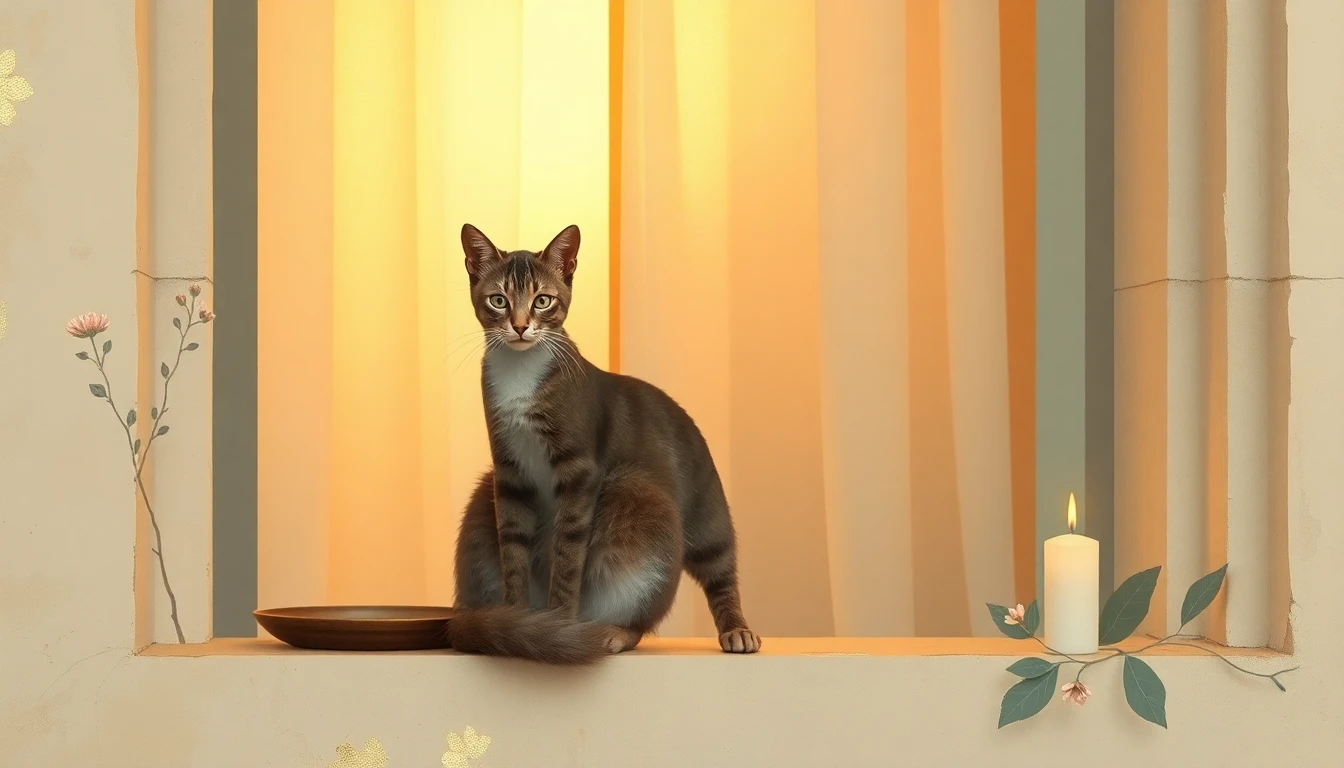
If you have spent years explaining yourself — every absence, every "no", every preference — the cat is the quiet teacher who has been waiting on the windowsill for that explanation to stop. She was honored in ancient Egypt as a form of the goddess Bastet. She was never truly domesticated: she joined human company because it suited her, and her medicine is the right to live on your own account.
The Medicine of the Cat
Domestic cats are genetically almost indistinguishable from their wild ancestors. They are one of the few mammals that joined human company without giving up their own nature. Their communication with us — the meow — they developed specifically for us; among themselves they barely use it. That is a remarkable detail: the cat speaks a special language for the human, while remaining inside her own logic.
Her medicine is sovereign self-will. The cat goes when she wants to go. She comes when it suits her. She shows affection when it fits her. In human categories she is "untrainable" — and that is exactly her gift. To carry the cat is to stop explaining every movement of your own.
In ancient Egypt, killing a cat carried the death penalty. The Greek historian Herodotus reports that when a household cat died, the entire family shaved their eyebrows in mourning. That reverence was not sentimentality but theological practice: the cat was understood as a living form of Bastet, one of the most important goddesses of the land. Anyone who keeps a cat at home today carries a thread of that old veneration without knowing it.
The Teaching
The first teaching of the cat is the art of choice. A cat chooses where she sleeps, whom she greets, what she eats. She cannot be forced. For women who have spent a lifetime learning to accommodate, the cat is a late, healing teacher. She asks: what do you actually choose? And: where have you forgotten that choosing is possible? She gives no answer — she gives only the question, and gives it again until the answer becomes honest.
The second teaching is bodily self-care. Cats groom themselves for hours. That apparent vanity is in truth a sensual ritual of being inside the body. To carry the cat is to stop merely operating your body and begin to inhabit it. In the Soul Name guide the cat is assigned to profiles meant to defend their sovereignty in everyday life.
The third teaching is the purr as a healing vibration. Studies suggest cats purr in a frequency range between roughly 20 and 140 Hertz — a band associated with bone repair and tissue regeneration. Cats purr not only when content but also when in pain or stress, as a kind of self-soothing. To carry the cat is to learn that wellbeing is not a passive state but an active one that releases energy. For wider context see the overview on power animals.
The Shadow
The cat shadow is indifference. Pushing independence so far that it no longer needs others forgets that the cat herself joined human company on her own — because she too wants warmth and closeness, when she decides. The second shadow is the cruelty of the hunter: tormenting the mouse in play. Translated into the human, exercising power out of boredom. A mature cat-bearer notices when she is hurting someone simply by routine, and stops.
If you want to feel which of the five elemental archetypes you are carrying — and whether the cat-energy in you is right now medicine or shadow — the free 60-second soul-type quiz is here. It gives you a first archetype hint without asking for an email, and many cat-bearers recognize their own logic in it immediately.
When This Animal Appears
The cat arrives when you have been too compliant for too long and need your own edge back. After decades of accommodation, after a marriage that made you invisible, in a professional reorientation. She often comes in perimenopause, when many women ask for the first time in years: what do I actually want? Often she announces herself when everything suddenly seems too loud and too crowded — a bodily sensitivity that says: too much foreign, too little your own.
Invocation
Cat, teach me the self-will that needs no reason. Let me come when I want to come — and leave without apology. Sit beside me when it suits you, and go without my asking.